


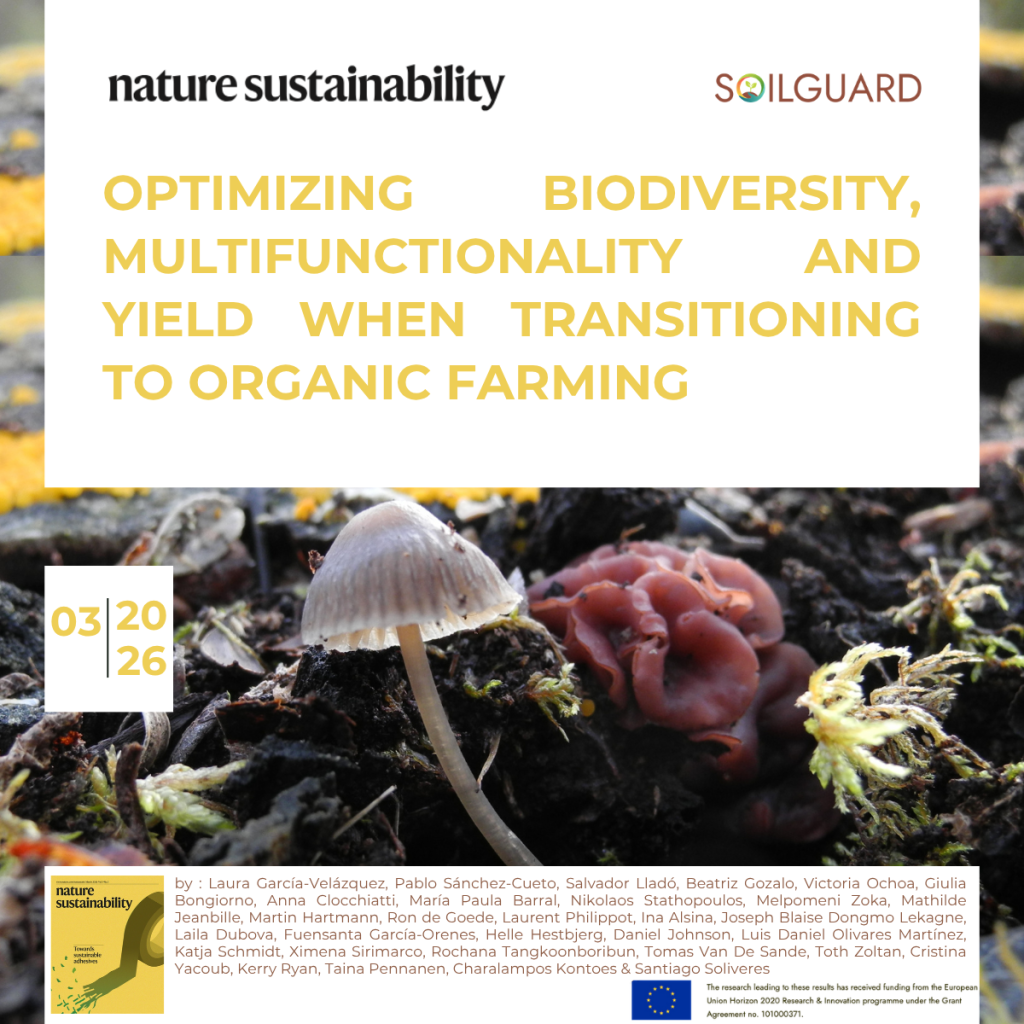
Balancing productivity and biodiversity: landscapes with 50% organic farming can optimize soil health and yields
A new study published in Nature Sustainability provides strong evidence that transitioning to organic farming can enhance biodiversity and soil functions without compromising agricultural productivity. The research, led by Laura García-Velázquez from the University of Alicante, in Spain, analyzed 179 croplands across eight countries and found that agricultural landscapes with up to 50% organic management simultaneously maximize crop yield, soil biodiversity, and ecosystem multifunctionality.
Contrary to the long-held belief that organic practices inevitably reduce yields, the study shows no major trade-offs between productivity, nitrogen availability, and soil biodiversity at the farm level. In fact, organic farming was found to improve soil carbon storage, nutrient cycling, and enzymatic activity — key processes for climate regulation and sustainable crop production.
The researchers also identified where this transition would be most beneficial: in moderately to highly degraded soils, where environmental gains are greater and yield losses are minimal. This spatially targeted strategy could help meet global food demands while halting soil degradation and biodiversity loss.
Conducted within our project SOILGUARD, the work offers critical insights for European and international agricultural policies, including the EU’s Farm to Fork Strategy, which aims to reach 25% organic farming by 2030. The findings suggest that this target might need to be more ambitious, as achieving around 50% organic coverage at the landscape scale appears optimal for balancing productivity and sustainability.
Find the paper’s abstract below:
Agricultural intensification increases crop production but often causes declines in soil biodiversity and functioning, thus threatening long-term environmental sustainability. To buffer these impacts, environmental policies aim to increase the amount of organic farming; however, this potentially compromises yield and nitrogen and phosphorus availability. Given such complexities, we evaluated the overall impacts of shifting agricultural management by comparing the effects of conventional versus organic farming on soil biodiversity (richness of 6 faunal and microbial groups), functioning (21 indicators) and crop yield on 179 global croplands across a wide range of ecological contexts, including contrasting levels of soil degradation.
High crop yields did not necessarily trade off against soil biodiversity, ecosystem multifunctionality or nitrogen availability, with often positive correlations found between them. Yield, biodiversity and functioning variables showed a broad range of values within and between conventional and organic sites. Despite this large variation, we found that landscapes with 50% organic agriculture could optimize crop yields, biodiversity and multifunctionality. Our findings provide guidelines for sustainable agriculture, showing how prioritizing the transition to organic farming in moderately to highly degraded soils would maximize its benefits while minimizing yield loss.
Abstract from García-Velázquez et al. (2026), Nature Sustainability.
Link to the article for more details: https://www.nature.com/articles/s41893-026-01791-1